
Experimental Result
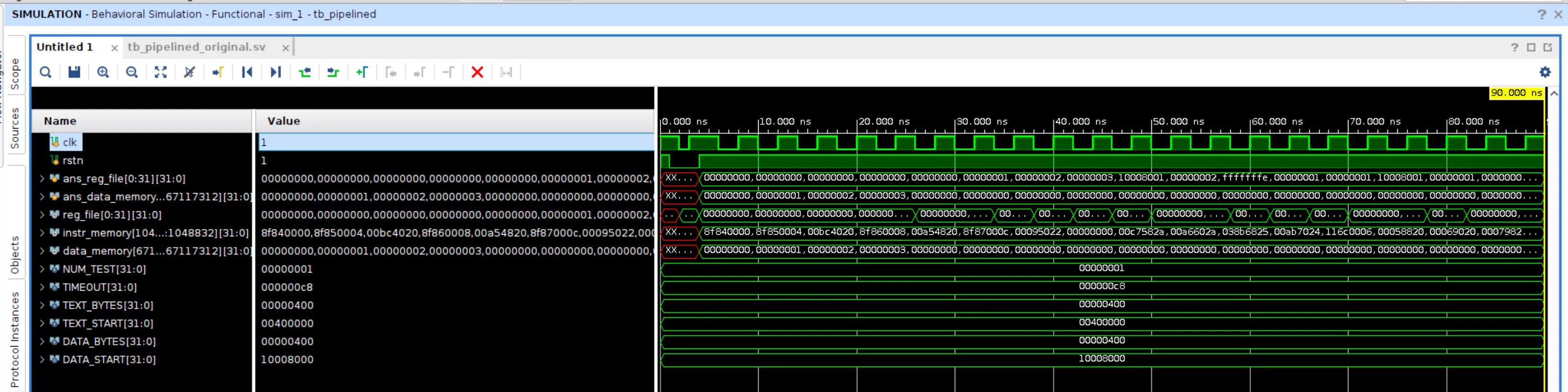
Answer the Following Questions
1. (2%) List out the equation to detect EX & MEM hazard in forwarding unit. Which part of the equation in textbook p.369 is wrong?
EX hazard:
if (EX/MEM.RegWrite
  and (EX/MEM.RegisterRd != 0)
  and (EX/MEM.RegisterRd == ID/EX.RegisterRs))
  ForwardA = 10

if (EX/MEM.RegWrite
  and (EX/MEM.RegisterRd != 0)
  and (EX/MEM.RegisterRd == ID/EX.RegisterRt))
  ForwardB = 10
MEM hazard:
if (MEM/WB.RegWrite
  and (MEM/WB.RegisterRd != 0)
  and NOT (EX/MEM.RegWrite and (EX/MEM.RegisterRd != 0)
             and (EX/MEM.RegisterRd == ID/EX.RegisterRs))
  and (MEM/WB.RegisterRd = ID/EX.RegisterRs)) ForwardA = 01

if (MEM/WB.RegWrite
  and (MEM/WB.RegisterRd != 0)
  and NOT (EX/MEM.RegWrite and (EX/MEM.RegisterRd != 0)
             and (EX/MEM.RegisterRd == ID/EX.RegisterRt))
  and (MEM/WB.RegisterRd = ID/EX.RegisterRt)) ForwardB = 01
課本 P.369 的 MEM hazard 少判斷「當下 NOT EX hazard」,否則當 double data hazard 出現時:
add $1, $1, $2
add $1, $1, $3
add $1, $1, $4
第三條 add $t1, $t1, $t4 會誤判成來自前兩條指令的 MEM hazard,而非前一條指令的 EX hazard(後者才對)。
2. (2%) In forwarding for beq, is forwarding from MEM/WB to ID needed? Why?
不需要:
- WB stage 將新資料寫回 register file 時是在同一個 clock 的前半(
negedge clk) - register file 讀取以及 register comparator 是 combinational circuit
- PC 和 pipeline registers 是在 clock 的後半(
posedge clk)更新
不用做額外的 forwarding 就可以是新的資料。
3. (2%) Briefly explain how you insert 2 stalls when beq reads registers right after lw writes it.
讓 hazard detection unit 在 lw 的 ID/EX 與 EX/MEM 這兩個 stage 都能連續偵測到需要 stall:
- 1st stall:
ID/EX.MemRead == 1 and (ID/EX.RegisterRt == IF/ID.RegisterRs or ID/EX.RegisterRt == IF/ID.RegisterRt) - 2nd stall:
EX/MEM.MemRead == 1
  and (EX/MEM.RegisterRt == IF/ID.RegisterRs
    or EX/MEM.RegisterRt == IF/ID.RegisterRt)
4. (2%) sw right after lw is quite common since copy and paste a data from one address to another is used frequently. In textbook, a stall is followed by the lw in this case. Is it possible to remove this stall? How?
可以只用 forwarding 就行,參考如下指令:
lw  $t1, 0($t2)        IF      ID      EX      MEM     WB
sw  $t1, 0($t3)                IF      ID      EX      MEM     WB
sw 需要寫到 memory 的資料來自於 lw 的 MEM stage 結束之後,可以發現剛好接得上。所以就直接仿照 EX stage 那樣再接一個 forwarding unit 於 MEM stage 結束後:
lw  $t1, 0($t2)        IF      ID      EX      MEM     WB
                                                    \
sw  $t1, 0($t3)                IF      ID      EX      MEM     WB